.svg)
Table of Contents


Just a few years ago, customer data was seen as a bonus. A little something extra to refine a marketing campaign or tweak an offer. Today, it’s the complete opposite: data is at the heart of strategy. We talk about data-driven marketing, data-focused business, and data-centric companies. And for good reason: everything depends on it. But this race for data raises a real ethical question: can we exploit everything without infringing on privacy?
With GDPR, internet users have regained a certain level of control over their personal information. And that’s a good thing. Because at a time when customer trust has become a condition for survival, brands must play fair. This is where a “Data First” strategy truly makes sense. Rather than relying on data purchased or cross-referenced through opaque partners, we focus on one simple thing: the data we collect ourselves, with the customer’s consent.
It’s transparent, effective, and above all… sustainable.
Data First: what does that actually mean?
Making data a priorityis all well and good. But you still need to know which data you’re talking about. In a “Data First” approach, a company relies primarily on the data it collects itself: forms, browsing behavior, SMS, purchases, customer service, survey responses… All this information is personal data provided voluntarily by the customer.
This is what we call first-party data. It is different from third-party data (purchased from third-party platforms) or even second-party data (shared by partners). And this detail changes everything: it is more accurate, better contextualized, and above all… more GDPR compliant.
This data-driven model, based on what you truly own, requires a rethink of your strategy: better collection, better sorting, better security. And behind this lies a huge opportunity: the chance to build a more human, more direct, and more lasting customer relationship.
How this changes customer relations
With a Data Firststrategy, you stop marketing in the dark. No more mass emails sent without logic. From now on, every message is based on real behaviors, observable data, and contact history.
A customer visited your site three times without buying? They receive a targeted message. Another ordered once 6 months ago? They enter an automated sequence re-engagement. Everything is designed to speak to the right person, at the right time, with the right message.
And the more relevant your message, the more lasting the relationship becomes. This is another facet of digital transformation : moving from noisy marketing to intelligent, personalized communication driven by actual behavior.
There is no shortage of tools, but strategy must come first
Many companies launch a data-centric strategy by starting with the tech: CRM, automation tools, segmentation platforms, dashboards... However, it is not the tool that creates the strategy, but the other way around.
Before choosing your stack, ask yourself the right questions:
- What data are we collecting today?
- Where is it stored?
- Who has access to it?
- Are we respecting our users' consent?
- What do we want to learn about our customers, and for what purpose?
This clarity is what will then allow you to choose the right tools. A well-configured CRM, connected to your email marketing or your automation tools automation, can already work wonders. And if you are just starting out, there are now no-code solutions perfectly suited for SMEs.
What matters is consistency.
The challenge of Data First segmentation : not speaking to everyone in the same way
When we talk about data utilization, we often think about volume. But in marketing, it is segmentation that makes all the difference. The better you segment, the more relevant you are.
Imagine: you have an e-commerce site. You collect browsing preferences, purchase history, and email open behavior. Thanks to this, you can create automated customer journeys tailored to the individual: discovery, recommendation, replenishment, and loyalty.
And here again, it’s a win-win: you offer content that is more useful and respectful, and your click-through, conversion, and satisfaction rates soar.
In short: you no longer speak to everyone the same way. You speak to each person, at their own pace, according to their needs. That is the true power of Data First.
Transparency, compliance, trust: the 3 pillars of GDPR
Implementing a Data Firststrategy is also about commitment. Not just technically, but ethically. And it starts with one thing: being transparent.
Your users need to know what you collect, why, and what you do with it. This requires clear disclosures, a privacy policy that is easy to read, and above all… real options: explicit consent, the right to deletion, the right to be forgotten, and data portability.
With the right consent management tool, all of this can be automated. In return, you earn customer trust. Because respecting data isn't just a legal obligation. It’s a powerful statement that shows you view your customers as partners, not as targets.
And that stance makes all the difference, especially in a world where privacy scandals are on the rise.
Case studies: how brands apply Data First
- A cosmetics brand collects preferences via an online quiz, then uses that data to recommend personalized routines via email.
- A training platform analyzes user behavior (pages viewed, modules accessed) to tailor follow-ups and content suggestions.
- A healthcare provider ask customers if they would like personalized SMS reminders for their treatment, with explicit and revocable consent.
These Data First examples show that the approach is not limited to tech. It is about listening, customer experience, and building a relationship based on respect.
Common pitfalls for beginners
Like any ambitious strategy, the Data First approach has its traps. The first is over-collection. By trying to know everything about everyone, you end up creating an unreadable—and unsettling—database for the customer.
Another pitfall is fake personalization. A simple but relevant message is better than content stuffed with poorly filled dynamic fields. Datais like a good tool: powerful when used correctly, counterproductive otherwise.
Finally, don't overcomplicate things. It is better to have a well-executed small project (such as segmenting your leads or a reactivation campaign for inactive users) than an endless mega-project.
The key? A gradual approach.
Training your teams: an underestimated lever
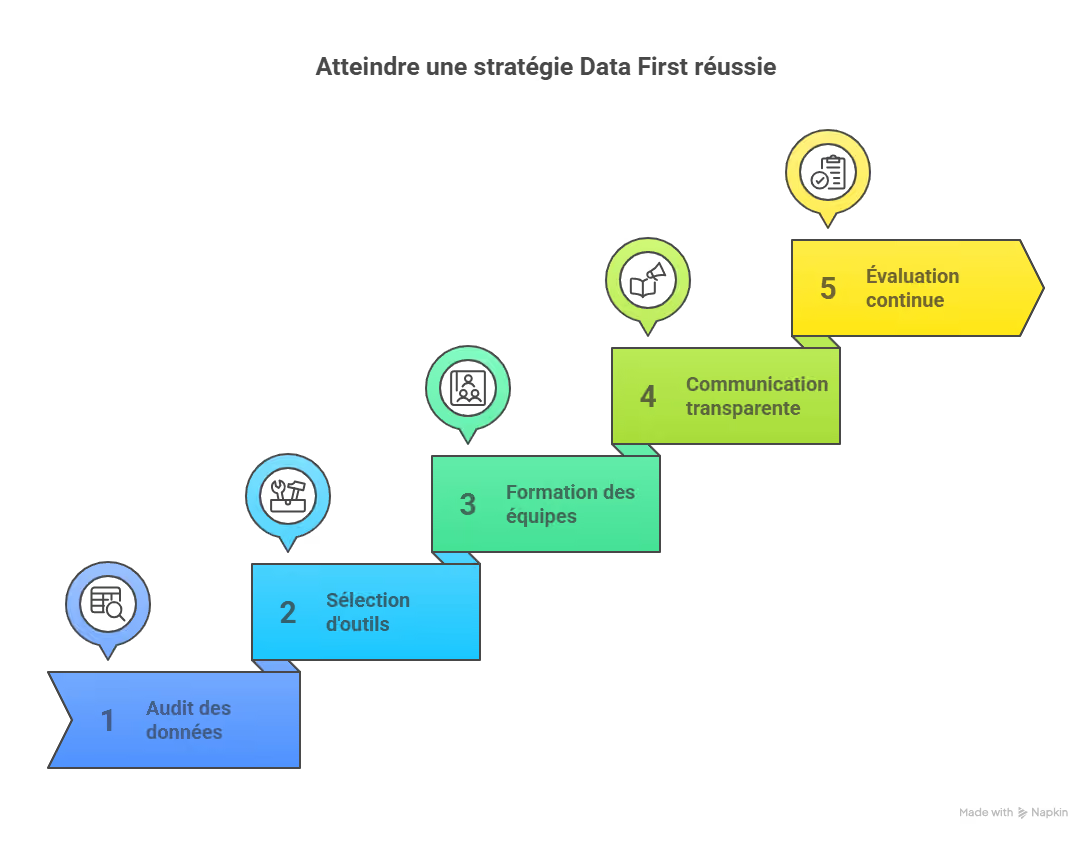
Last but not least, a data-driven strategyis also a matter of corporate culture. If your teams don't understand why you are collecting a specific metric, they won't be able to use it intelligently.
Organize workshops, offer Data First training, and show how data serves the customer, not just the stats. This human implementation is often the key to success.
Because ultimately, behind every line of data, there is a person.
Data as the foundation of a healthy relationship
The Data Firstapproach is not an option for the years to come. It is the foundation of an effective, ethical, and sustainable marketing strategy, and the guarantee of a balanced customer relationship where the brand relies on what it knows… and respects what it does not.
It is also a way to regain control over your tools, your audiences, and your decisions. Without waiting for platforms or cookies to do the work for you.
Not sure where to start? Keep it simple: an audit, a segmentation, a campaign. You will see, step by step, how data becomes a powerful… and respectful lever.