.svg)
Table of Contents

E- commerce relies increasingly on effective communication: according to the GSMA, RCS campaigns generate an average of 300% more engagement than standard SMS . RCS (Rich Communication Services) offers a rich channel capable of enhancing your messages, creating interactive experiences, and strengthening your customer relationships.
Why choose RCS messaging for e-commerce?
The RCS replaces the messaging traditional via a rich channel, capable of sending images, carousels, and clickable buttons. A simple SMS cannot compete: it is limited to text. RCS offers:
- read receipts (you know when the customer opens your message)
- integrated quick replies (one click is all it takes to respond)
- a customized interface (your companylogo, brandcolors)
This enriched format improves the rate andengagement. Businesses that adopt it report up to 300% growth in CTR (click-through rate) on their RCS campaigns (GSMA, Google Business Messages).
Rich features to boost your campaigns
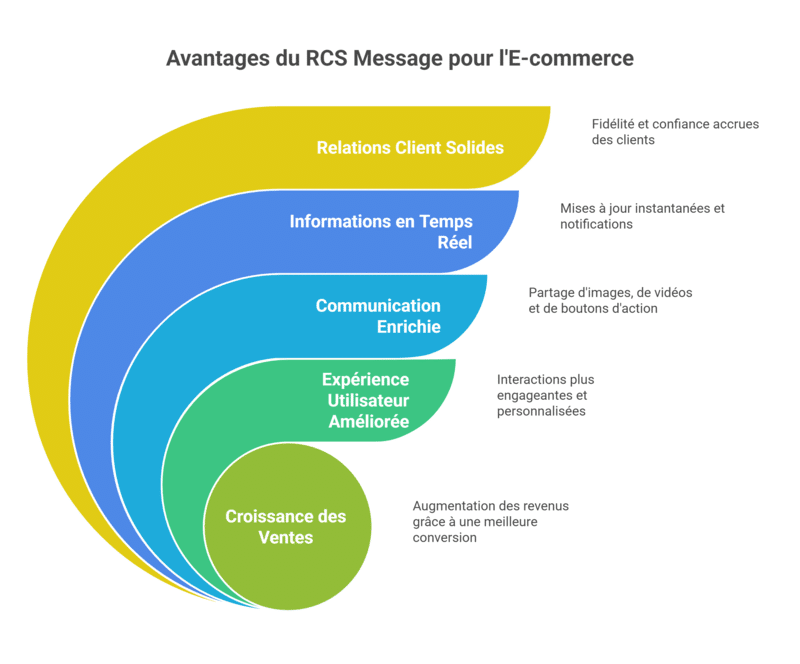
The benefits of RCS go beyond visuals. You can integrate:
- a carousel of products (ideal for showcasing multiple items)
- a “Buy now” button (direct link to your website)
- an interactive map (geolocation of your services)
- emojis and GIFs … but always in good taste
These features simplify the mobile experience: the customer browses, clicks, and orders without ever leaving the messaging app. No more invisible links or redirects lost in browser tabs.
How does RCS improve the customer experience?
Want to build customer loyalty?
- Offer instant after-sales support (integrated chat)
- Send notifications real-time package tracking
- Offer personalized promotions based on purchase history
"The customer feels taken care of," that is what makes the difference between a simple SMS and a true RCS experience: a fluid, content-rich exchange that highlights your brand .
Practical tips
- segment your lists to tailor the tone (VIP offers, cart abandonment reminders)
- test different formats (text only, image only, carousel)
- check how it displays on various mobile models (Android, iOS)
Common mistakes: forgetting to optimize image file sizes, sending too many messages, neglecting accessibility (alt text).
Deploying a winning RCS strategy
Are you considering RCS ? Follow this simple plan:
- Choose a certified RCS provider (check for Googlecompatibility)
- Define your goals (increased conversion rates, better retention)
- Design communication scenarios (follow-ups, onboarding, support)
- Launch a pilot on a small segment
- Analyze the results (open rates, responses, ROI)
These steps ensure an agile deployment. You can adjust as you go, without disrupting your processes.
Benefits and key considerations
- Benefits
- better deliverability (standardized messaging)
- embedded images and videos (no external links)
- detailed analytics (click-through rates, time spent)
- Things to watch out for
- higher costs than a SMS standard
- requires technical configuration (RCS API)
- adoption varies by customer (some devices do not yet support it)
Still unsure? Request a free trial from an RCS provider to measure the impact on your strategy.
Measuring the impact of your RCS campaigns

You are launching your first rich messages… but how do you know if the RCS pay off?
- Track open rates to gauge initial interest. A rising rate is often a sign of a well-targeted message.
- Compare the CTR (click-through rate) between your standard SMS and your RCS messages. You will immediately see where your communication is gaining engagement.
- Analyze the time spent interacting with your services (clicks on carousels, buttons). The longer a customer stays, the more likely they are to make a purchase.
- Look at the response rate to invitations for integrated chat. A rich chatbot can turn a simple message into a genuine conversation.
To measure is to learn. You adjust, test, and fix underperforming scenarios… and you can repeat what works. Companies that pay close attention to their metrics often see their ROI take off (a few percentage points are enough to reach the next level). So, are your campaigns RCS ready to level up?
Technical integration and best practices
Worried about the setup? Rest assured…
- Choose an RCS API compatible with your CRM. This step ensures seamless synchronization between your campaigns and your customerdatabase.
- Configure webhooks to receive real-time events (opens, clicks, replies). Capture every interaction and immediately adapt your strategy.
- Test on a panel of mobile devices (Android and iOS). A flawless display on all screens reinforces your brandcredibility.
- Respect image size limits (generally < 1 MB) and add descriptive alt text . Accessibility and speed: your customers will appreciate it.
- Plan for an SMS fallback for incompatible devices. You won't leave anyone behind, even those who haven't yet adopted the channel RCS.
These steps reduce bugs, ensure deliverability, and enhance the customer experienceHave you thought about documenting every test? A mini internal guide (a simple shared document) will save you from unnecessary back-and-forth. Involve your IT team from the start: solid technical support is the key to deploying your solutions rich smoothly.
Use case examples
- cart abandonment: message with a visual of the abandoned product and a "Pay" button
- flash sale: carousel of the day's best offers
- customer service: enhanced chatbot to answer frequently asked questions
- review collection: interactive form after delivery
Every business can adapt its RCS channel to its needs.
Launch your first RCS campaign
Ready to optimize your communication mobile? RCS is the ideal lever to enrich your campaigns, build customer loyalty, and boost your online business. Now is the time to rethink your strategy and adopt a channel firmly focused on user experience.
You could even run an A/B test (just to see what works best…). Be sure to set a realistic success rate and track your key metrics to adjust your scenarios as you go. Why not start today with a small pilot on a segment of your customers?