.svg)
Table of Contents

Media and communication technologies have evolved over the years, and political parties and labor unions are increasingly riding the wave of the connected citizen era to stay as close as possible to these technological and societal shifts. Whether it’s handing out flyers on the sidewalk, putting up posters, or sending mail, an election campaign is won primarily by connecting with individuals. More modern approaches, such as radio, television, or, more recently, social media, have made campaigns more competitive. With the adoption of mobile technology, the phone is gradually establishing itself as one of the most effective channels for creating leverage among voters, with a 98% open rate. As a political party or labor union, how can you use SMS to motivate your troops and run a successful campaign?
Plan your campaign well in advance:
Involving your target audience early enough is a crucial step for a successful campaign. SMS is an excellent way to foster consistent engagement with your voters at a level that is low-effort for them. They will be much more likely to be responsive if you have taken the time to communicate with them during the preliminary stages of your election campaign, rather than just when the pressure is on and you need their vote.
Clearly identify your electorate:
By segmenting your database based on demographic, geographic, and social criteria, you will be better able to identify the concerns of your electorate. This step is essential for targeting your communications. The NationBuilder software, well-known for being used as a grassroots mobilization tool during Barack Obama’s 2008 presidential campaign, allows you, among other things, to collect all the information gathered by activists in the field and then target SMS messages based on voters' specific concerns.
During the 2014 municipal elections in Marseille, Patrick Mennucci made no mistake about this, using NationBuilder to compile data on 12,000 out of 24,000 voters, which gave him the boost he needed to win by 300 votes over Samia Ghali.
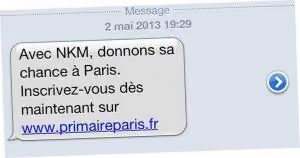
Nathalie Kosciusko-Morizet, in Paris, used certain software to boost her campaign. One of her proposals was that 95% of Parisians should have a green space within 250 meters of their home. By cross-referencing her database of 32,000 voters with the city of Paris's mapping, her team was able to identify exactly who was directly affected by this measure and send them targeted SMS messages.

Recruit effectively:
Send your campaign teams out to the streets to create dialogue and proximity, and to sign up new people for your SMS campaign. Direct contact with your potential future voters is the best way to understand their needs, find out if they are signed up for your SMS campaign, and build a personal connection. The information gathered will help you create an effective campaign strategy and allow you to recruit new subscribers to your database.
Define your campaign strategy:
All political parties and labor unions that run successful election campaigns have put thought into the content they send to voters beforehand. Which event will require a reminder a few hours in advance? When should you encourage activists to react to an opponent’s radio interview? These types of moments can be pivotal in a campaign, and knowing how to send the right message, at the right time, to the right people is crucial. During internal elections, unions make extensive use of SMS to call for votes.
The National Nurses' Union, struggling with mobilization during its 2014 internal elections, used SMS to re-engage its members.
Some examples of reminder and mobilization SMS:
- "Hi, don't forget to vote and get others to vote for XXXX today. Making a difference means voting for XXXX. We're counting on your vote." ;
- "XXX: according to the latest count, you haven't voted yet. This vote is vital for your union, every vote counts! Vote and get others to vote for XXXX before December 4th."
It is also possible to send personalized SMS messages by automatically inserting the recipient's first or last name, or other variable data.
Find the right keyword for your campaign:
Your campaign keyword must be punchy and representative of your campaign. An ideal keyword is relevant, easy to remember, and above all, a single word. Using the name of your organization or your representative seems to be the most appropriate choice for a keyword. It allows for immediate and easy recognition of your organization and fosters a sense of belonging and familiarity among the electorate.
Listen to your SMS campaign subscribers:
Thanks to its exceptional open rate and interactivity, SMS is a powerful tool for getting to know your electorate. Listening to those who have signed up for your SMS campaign is a major asset. What do your supporters have to say? Pay attention, as they are likely responding to your campaign with valuable insights: the issues that matter most to them, on-the-ground information, and more. Managing these responses is crucial; it allows your team to stay tuned in to what is happening on the other side of the conversation, in the real world!
For François Hollande's presidential campaign, the 50 + 1 software addressed a key need expressed by activists: a tool to guide volunteers during their field sessions.
Promote your keyword widely:
Advertise your campaign keyword! The most successful candidates on the mobile front are those who place their keyword just about everywhere: Twitter backgrounds, Facebook pages, websites, posters, mailers, and more. By integrating your mobile strategy into every aspect of your election campaign, you will see an unprecedented response rate.
Are you leading a labor union or a political party and want your election campaign to be a success? These tips will help you get off to a good start. Are you looking for an SMS provider to run your campaign at reasonable prices? Contact Octopush to learn more about our dedicated services.